Blogs
Allied Staffing Shortages: A Guide to Help Hospitals Respond

Table of Contents
The health systems making real headway on solving allied health staffing shortages are not just doing one thing. Instead, they are treating staffing as a deliberate sequence: understand the problem, build a strategy, execute with the right partners, and set up long-term resilience. More simply, it is Think, Plan, Do, Enable. None of these steps work in isolation, and there is no universal fix. But each one aims to nudge the dial in the same direction: lower total labor spend with better operational outcomes.
This guide walks through the four recommended steps. You can use it as a checklist to evaluate your own staffing strategy and try to find where it could be leaking money.
Think: Start with a diagnostic, not a purchase order
Before you commit to any fill strategy, it is vital to figure out how long your positions have been open and what is causing that length of vacancy. The reflex when faced with shortages is often to call an agency and place an order. It may be a smarter move to ask a few uncomfortable questions first.
- Is the market actually short, or is the hospital across the street offering a sign-on bonus you are not matching?
- Does the same role fill easily in outpatient in your market? If so, the problem may be your acute care schedule structure, not the talent supply.
- Is this vacancy a one-time departure, or a recurring turnover pattern pointing to something systemic?
The answer changes everything that follows. Filling allied roles also demands modality-specific expertise that generalist recruiting simply cannot replicate. An MRI tech search needs a recruiter who understands the technology platforms, knows which certifications matter, and has relationships inside a specialized candidate pool. Agencies that treat allied roles as an afterthought to nursing, or quietly hand the hard-to-fill orders off to subcontractors, tend to underdeliver on exactly the positions you need most.
Plan: Map exposure before allocating resources
Not all allied vacancies carry the same downstream cost, so it makes little sense to treat them as equal. An open position in a revenue-generating surgical department is a very different animal from an open position in a department that operates at a loss.
Hospitals that map operational and financial exposure by modality and department, before deciding where to spend their recruiting budget, can position themselves to make better decisions. Which vacancies are creating bed flow bottlenecks? Which are deferring surgical volume you cannot get back? Prioritizing by downstream cost rather than time-to-fill could change what action you decide to take and the return you get on every staffing dollar.
It also helps to draw a clear line between two kinds of contingent coverage. Some roles are covered by contingent labor as a deliberate bridge to a permanent hire. Others have drifted into being indefinitely contingent because no one ever addressed the root cause of the vacancy. It is important to differentiate which you are experiencing. Those two situations look identical on an invoice but demand completely different responses. Name which is which, and set an endpoint for the bridge before you build it.
Do: Use contingent labor and care team design as tools
Here is the part that may feel counterintuitive. When used strategically, contingent allied staffing is often cheaper than hospital leaders assume. On a true hourly basis, bringing in a traveler to cover a vacancy frequently costs less than the overtime premium you are already paying internal staff to absorb the gap. The math only turns against you when travelers become a permanent fixture because the underlying problem never gets solved.
Allied staffing also has a strong temp-to-perm dynamic, and it is one of your best-kept advantages. Contract placements that convert to permanent hires are among the most efficient ways to build a team in a thin market. They also tend to carry lower risk than a traditional permanent search, because both sides have had real time to evaluate the fit before anyone signs.
On the care team design side, some health systems are rethinking how they deploy allied professionals rather than simply trying to hire more of the same. In practice, this means nurses work at the top of their clinical scope while allied professionals take on support functions that nursing had absorbed like phlebotomy, IV starts, mobility assessments, or patient monitoring. A well-structured allied team can simultaneously help lower the burden on nursing, reduce overtime, and bring down total labor cost per patient.
The numbers can be striking. One published example from America’s Essential Hospitals found that increasing morning physical therapy in post-surgical sessions cut one hospital’s length of stay by 31 percent, saving roughly $650,000 a year. That was an allied staffing decision that translated directly into cost savings, not a soft quality metric that lives only in a board deck.
Enable: Address root causes and plan for what is coming
Now that the present is in order, it is time to think ahead. The most resilient health systems are the ones asking what will be true in 18 months, not just reacting to today. That mindset can show up in three practical habits.
- Asking staffing partners harder questions. Beyond your fill rate, what are you doing to grow the long-term pipeline in the markets where we operate? A partner who can only answer the first half of that question is a vendor. A partner who can answer both is building you a future.
- Addressing policy gaps where they exist. The allied workforce has historically been left out of the loan forgiveness and reimbursement programs that help draw nurses into underserved markets. Partners willing to help develop pipeline programs, whether through scholarship funding, earn-to-learn models, or advocacy for policy change, create structural advantages that reactive recruiting can never match.
- Adapting to today and tomorrow’s technology. AI is beginning to reshape imaging interpretation, diagnostic workflows, and clinical triage in ways that will shift the skills mix allied roles require over the next several years. Health systems baking AI readiness into their hiring criteria today can spend less retraining and replacing staff as those workflows mature. The window to make that a deliberate part of talent strategy is now, not after the change has already landed.
Putting the four steps together
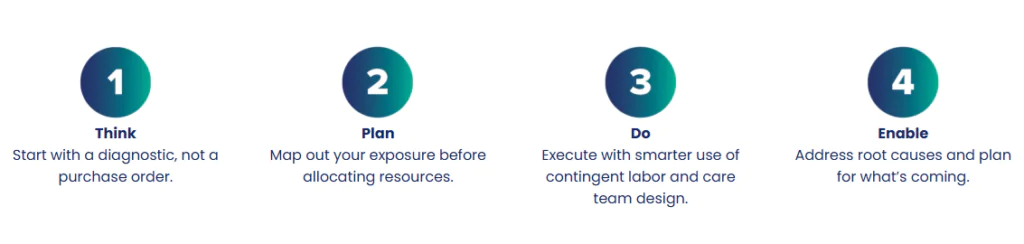
Think, Plan, Do, Enable is not a rigid playbook to run once and shelve. It should be a continuous loop. That means consistently diagnosing, mapping exposure, balancing the right mix of contingent labor with your care team, and enabling the development of a long-term pipeline. The sequence will become sharper each time, as you run through it for every new vacancy. The systems that treat allied staffing as a recurring strategic discipline, rather than a series of one-off fire drills, are better positioning themselves to respond to shortages and lower their total labor spend.
The shortage is real and it is not going away soon. But how you respond to it is entirely within your control. The response is what separates the systems that absorb the cost from the ones that get ahead of it.
Want to see how strategic allied health staffing can help your hospital?
Get the latest blogs, news and company updates
Want to get the latest staffing related news and updates? Subscribe to our resources to get insights sent straight to your inbox.