White Papers
What Allied Health Shortages Are Really Costing Hospitals

Walk into any hospital and you see nurses at the station, doctors making rounds, maybe a physician’s assistant pulling up a chart. What you do not see is the imaging technologist two floors down who cleared three patients for surgery this morning, the respiratory therapist managing a ventilated patient in the ICU, or the surgical technologist who has been in the OR since 6 a.m. keeping the operating schedule on track.
These are allied health professionals. They perform the diagnostic work, therapy, and technical support that the rest of the care team depends on. And right now, they are in short supply across the country.
The allied health staffing shortage is not a secret. Most hospital leaders know their vacancy numbers. What many are underestimating is what those vacancies are actually costing them, not just in recruitment fees or temporary labor premiums, but in delayed discharges, deferred surgical revenue, weakened payer contracts, and eroding quality scores that flow directly into Medicare and Medicaid reimbursements.
The hospitals getting ahead of this problem are not doing so by spending more, but by approaching staffing more strategically. This article examines how a smarter approach to allied health staffing helps you fill the gaps while reducing total labor spend.
The Challenge at Hand

With 85% of hospitals reporting shortages of allied healthcare professionals, this problem goes beyond a staffing cycle. It is the product of structural forces that have been compounding for years, and it will not resolve without deliberate action[1].
Workforce departures outpaced replacements
The COVID pandemic appears to have accelerated allied health workforce departures, and the effect is still visible in the data. According to the American Society of Radiologic Technologists (ASRT), vacancy rates across all medical imaging disciplines remained above their 2020 levels, with computed tomography reaching an all-time high of 19.4% in 2025. While some radiology disciplines saw modest declines from 2023 peaks, the report notes overall vacancy rates still remain at or near record highs[2].
Training programs have not kept up
The number of clinical laboratory training programs has dropped from nearly 1,000 to fewer than 450 since 1970[3]. Accredited surgical technology programs have declined from more than 500 to around 430 in recent years[4]. When programs close, they are rarely replaced and consequences become dire. In Oregon, trade school closures have left over 600 difficult to-fill medical assistant vacancies across the state[5].
Demand surged in ways nobody planned for
Rising insurance denial rates have prompted hospitals to order more upfront imaging to justify procedures. Medicare Advantage plans denied approximately 17% of initial claims in recent years, and the share of prior authorization appeals climbed from 7.5% in 2019 to 11.5% in 2024[6]. This meant imaging demand spiked without any corresponding growth in trained professionals.
The allied workforce received fewer resources
Many states offer student loan forgiveness programs for healthcare workers, but those programs are frequently restricted. Kansas is a clear example, where forgiveness program covers nurses, but not allied professionals. States with that kind of policy gap are structurally disadvantaged in attracting permanent allied talent.
Fixing this problem means recognizing that hospitals are not just short-staffed. They are structurally undersupplied. That distinction matters. The typical response to staffing gaps is to recruit harder, but structural undersupply needs a different approach entirely.

of hospitals reporting shortages of
allied healthcare professionals

computed tomography vacancy
rates at an all-time high

Medicare Advantage initial
claims denied in recent years
What It’s Costing You
Hospital leaders know they have allied vacancies. What many are underestimating is how far the damage spreads from each one. Depending on the department, a single open position can reduce bed throughput, defer surgical revenue, weaken payer negotiations, and chip away at the quality scores that drive reimbursement. The factors stack up in ways that rarely appear on a single line of the budget.

of all clinical decisions are informed
by diagnostic test results[7]

of total hospital expenditure
is on operating ICU beds[8]
Operational Consequences
Bed flow and length of stay.
Approximately 70% of all clinical decisions are informed by diagnostic test results[7]. When allied professionals are short, those decisions slow down. ICU patients waiting on labs or PT clearance stay in the hospital’s most expensive beds longer than medically necessary, while those beds stay unavailable for new admissions. This is worrisome since operating ICU beds is significantly more expensive than running general ward beds
and accounts for roughly 20% of total hospital expenditure[8].
Patient experience and quality scores.
Understaffed departments produce longer wait times, slower response, and reduced patient satisfaction. That shows up in HCAHPS scores and Joint Commission outcomes, both of which tie directly to Medicare and Medicaid reimbursement rates. For patients, delays in receiving care and long wait times often cause them to seek alternative care outside of that hospital system.
Preventive care gaps and patient safety.
When imaging and diagnostic staff are short, routine screenings and follow-ups get pushed out. This can be dire for patients as research shows deferral of preventive imaging during COVID led to measurable increases in late-stage cancer diagnoses in the following years[9]. Staffing gaps that delay diagnostics can also lead to consequences that show up in litigation and regulatory exposure.
Financial Consequences
Surgical revenue that does not get recovered.
Surgeries generate up to 70% of total hospital revenue, and more than a quarter of inpatient stays involve at least one operating room procedure[10], [11]. Offering these services depends on having adequate surgical technologist staffing. When surgical techs are short, OR capacity shrinks and deferred procedures often become lost revenue. That loss impacts more than the surgical department itself, since elective surgeries generate much of the margin to subsidize less profitable service lines. Heritage Valley Health System in western Pennsylvania illustrates the compounding effect. The system’s CEO said that it never fully recovered financially from the pandemic, and after COVID, it became difficult to recruit and retain staff while competing with much larger systems[12], [13]. This led to an uncertain future for the health system and prompted the signing of an agreement to be acquired by Allegheny Health Network[14].
Payer contracts negotiated from weakness.
Insurers track timely discharge rates as a key performance metric, and those rates factor directly into reimbursement and contract negotiations. A hospital running short on allied staff holds patients longer than the insurer’s expected discharge window. That is a double loss: the hospital is not getting the new patient into the bed, and is being paid less for the patient still in it. When payer contracts renew, hospitals with poor timely discharge metrics have less negotiating leverage.
Reimbursement rate exposure.
The quality problem and the financial problem are the same problem. Poor HCAHPS scores reduce Medicare and Medicaid reimbursement through the Hospital Value-Based Purchasing program. Joint Commission findings tied to understaffed departments create additional compliance risk. In an environment where the average hospital operating margin is thin[15], these indirect revenue losses can be as damaging as the direct ones.
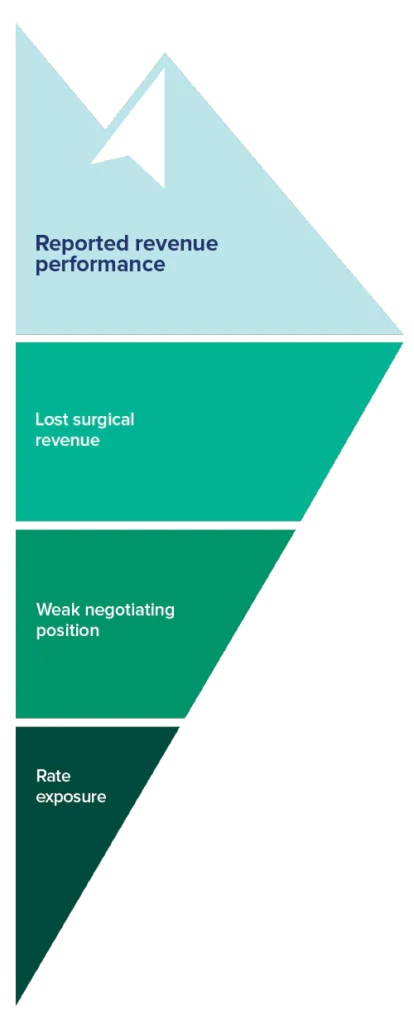
Only part of the problem is visible
Don’t Underestimate Your Allied Vacancies
Most hospital leaders are measuring the wrong thing. They track vacancy rate and time-to-fill. What they are not tracking is what the vacancy is doing to bed utilization, payer leverage, and surgical revenue while it sits open. The gap between those two views of the problem is where money quietly disappears.
Three places hospitals most commonly underestimate the damage:
Treating allied shortages as a subset of their nursing problem
The candidate pools, credentials, schedules, and fill strategies are fundamentally different. Allied professionals are often tied to specific equipment systems and have specialty certifications that are not interchangeable across modalities. They tend to have lower workforce mobility than nurses, which means they are harder to replace when they leave and harder to attract through the same channels. Applying a nursing-centric recruitment playbook to allied roles produces predictably poor results.
Assuming contingent labor is always more expensive than internal staffing
On an hourly basis, a traveler is frequently cheaper than paying existing staff at overtime rates. The real cost driver is relying on contingent labor indefinitely because the underlying vacancy is never addressed. The goal is to use temporary staff as a bridge while a permanent hire pipeline is built, not as a permanent fixture that obscures a structural problem.
Focusing on filling today’s opening rather than solving the underlying issue
Without a diagnostic view of the local market, the same positions turn over at premium cost, quarter after quarter. Understanding whether the problem is market supply, competitive compensation, schedule structure, or something else entirely requires asking a variety of questions before committing to a fill strategy.
The Opportunity Inside the Problem
Allied health shortages are structural, regional, and getting more expensive to ignore. The vacancy is the smallest part of the cost. The real number is what that vacancy is doing to bed throughput, surgical scheduling, payer reimbursements, and the quality scores that drive revenue under value-based payment models. Most hospital finance teams track nursing and physician staffing costs closely. Allied health costs tend to be less visible, less rigorously tracked, and, as a result, chronically underestimated.
Shifting mindsets on allied health staffing takes diligence and carefully thought-out steps:

Think
Start with a diagnostic, not a purchase order.

Plan
Map out your exposure before allocating resources.

Do
Execute with smarter use of contingent labor and care team design.

Enable
Address root causes and plan for what’s coming.
The systems making meaningful progress on allied health staffing challenges are not doing one thing differently. They are moving through a deliberate sequence: understanding the problem, building a strategy, executing with the right partners, and enabling long-term resilience. None of these steps work in isolation, and there is no universal solution. But each one moves the needle in the same direction: lower total labor spend with better operational and patient outcomes.
Strategic allied staffing done right costs less. The opportunity to seize those savings is real.
It starts with understanding your specific situation clearly enough to act on it.
References
- Healthcare Workforce Coalition. (2026). Issues. Healthcare Workforce Coalition. https://healthcareworkforce.org/issues/
- Bell, B. (2025, July 24). ASRT Staffing and Workplace Survey Shows Vacancy Rate Increases Near Record
Highs, Aligning With Overall Health Care Profession Trends. American Society of Radiologic Technologists.
https://www.asrt.org/main/news-publications/news/article/2025/07/24/asrt-staffing-and-workplace-surveyshows-vacancy-rate-increases-near-record-highs-aligning-with-overall-health-care-profession-trends - The American Society for Clinical Laboratory Science. (2026). Clinical Laboratory Personnel Shortage.
ASCLS. https://ascls.org/workforce/ - Cerutti, E. (2024, May 9). Hospitals Confront Surgical Tech Shortage. Becker’s Hospital Review; Becker’s
Healthcare. https://www.beckershospitalreview.com/workforce/hospitals-confront-surgical-tech-shortage/ - Li, T., Irvin, V., Luck, J., & Bahl, A. (2025). Oregon’s Health Care Workforce Needs Assessment 2025. Oregon
Health Authority. Oregon State University College of Health. https://www.oregon.gov/oha/HPA/HP-HCW/
Documents/2025-Health-Care-Workforce-Need-Assessment-report-final.pdf - American Hospital Association. (2026, March). Costs of Caring: Challenges Facing America’s Hospitals as
They Care for Patients in 2026. AHA; American Hospital Association. https://www.aha.org/costsofcaring - World Health Organization. (2026). Strengthening Diagnostics Capacity. WHO; World Health Organization.
https://www.who.int/activities/strengthening-diagnostics-capacity - Tatsis, F., Gouva, M., Dragioti, E., Veroniki, F., Stamatis, K., Papathanakos, G., & Koulouras, V. (2025). CostEffectiveness in Critical Care: A Systematic Review of Empirical Evaluations. Healthcare, 13(21), 2783. https://
doi.org/10.3390/healthcare13212783 - Bajaj, S. (2023, August 4). Pandemic Slowed Cancer Diagnoses, but Late-Stage Cancers Came Back with
a Vengeance. STATNews; STAT. https://www.statnews.com/2023/08/04/pandemic-cancer-diagnoses-latestage/ - McDermott, K. W., & Liang, L. (2021, August 31). Overview of Operating Room Procedures During Inpatient
Stays in U.S. Hospitals, 2018. Healthcare Cost and Utilization Project (HCUP) Statistical Briefs; Agency for
Healthcare Research and Quality (US). https://www.ncbi.nlm.nih.gov/books/NBK574416/ - Perez, E. R., Kerko, R., Lever, N., White, A., Kahf, S., & Avella-Molano, B. (2022). Operating Room Relay
Strategy for Turnover Time Improvement: A Quality Improvement Project. BMJ Open Quality, 11(3), e001957.
National Library of Medicine. https://doi.org/10.1136/bmjoq-2022-001957 - Havranek, A. (2026, February 16). Community Weighs in on Proposed Merger Between 2 Area Hospital
Systems. WPXI. https://www.wpxi.com/news/local/community-weighs-proposed-merger-between-2-areahospital-systems/HEVYYYUBVFCAZB5VEB67SCT7QQ/ - Sayer, R. (2025, October 16). Heritage Valley Hospitals Join Allegheny Health Network. CBS News Pittsburgh;
CBS News. https://www.cbsnews.com/pittsburgh/news/heritage-valley-allegheny-health-network/ - Havranek, A. (2025, October 16). Heritage Valley Signs Affiliation Agreement to Join Allegheny Health
Network. WPXI. https://www.wpxi.com/news/local/heritage-valley-signs-affiliation-agreement-join-alleghenyhealth-network/ZR6UM2MYQRFQ7ICP32AQH5LLHQ/ - Hulver, S., Levinson, Z., Godwin, J., & Neuman, T. (2025, February 19). Key Facts About Hospitals. KFF. https://
www.kff.org/health-costs/key-facts-about-hospitals/?entry=hospital-finances-profit-margins
Do you need help quickly finding qualified healthcare professionals for your facility?
Get the latest blogs, news and company updates
Want to get the latest staffing related news and updates? Subscribe to our resources to get insights sent straight to your inbox.