Blogs
ER Nurses Self-Care: Finding Balance in a High-Stress Career

Table of Contents
Managing ER nurse burnout
You chose emergency nursing for a reason—the adrenaline, the impact, the moments where patients who seemed critical walk out under their own power. That version of the ED is real. But so is the other one: twelve-hour shifts that turn into fourteen, patients in hallways, and back-to-back trauma cases with no time to decompress. Over time, burnout stops feeling like a possibility and starts feeling inevitable.
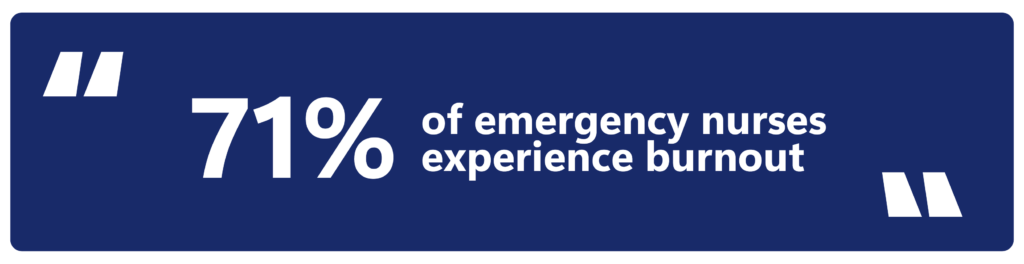
The data reflects this. A 2025 study published in the Journal of Emergency Nursing found that over half of emergency nurses reported high levels of burnout. With some estimates reaching as high as 71%.
But burnout isn’t a sign that you chose the wrong career. It’s what happens when talented, committed people are placed in systems that don’t give them room to breathe. The good news? You have more options than you may realize.
Why working the traditional way causes burnout
Full-time ED positions were designed for a different era. The expectation of consistent 36-to-40-hour workweeks, the same unit, the same pressures, shift after shift, leaves little space for recovery. Add to that the unpredictability of ED volume, frequent mandatory overtime, and workplace violence at rates higher than other clinical settings, and it’s no wonder so many experienced nurses are asking themselves whether they can keep doing this.
It’s no surprise that many nurses cite flexibility, not just pay, as a top reason for considering a change. Often, the issue isn’t nursing itself but the structure surrounding it.
Use flexibility as a self-care strategy
Per diem (PRN) can be one practical way to support a healthier work-life balance. Instead of adjusting your life around a rigid schedule, PRN work allows you to choose shifts that align with your personal and professional needs.
With per diem work, you can:
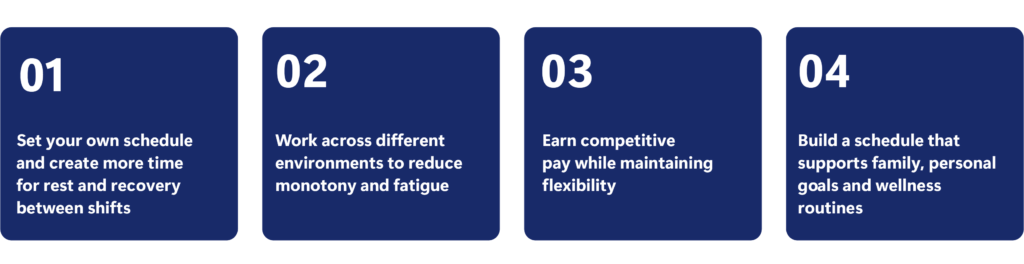
For many nurses, PRN work isn’t about stepping away from emergency medicine; it’s about creating a sustainable way to continue doing the work they love.
Alternative ER settings to consider
Freestanding emergency departments, urgent care hybrids, and suburban community EDs often operate at different paces and with different patient acuity levels than large urban trauma centers. Some ED nurses find that shifting to a smaller facility, even temporarily, gives them room to reconnect with what they loved about emergency nursing in the first place.
Protect your wellbeing
Protecting your wellbeing isn’t selfish – it’s essential. Emergency nursing is one of the most technically demanding and emotionally complex specialties in healthcare, but providing excellent patient care starts with caring for yourself. Whether that means prioritizing sleep quality, seeking emotional support, or embracing a more flexible PRN schedule, small changes can make a great impact. The skills you’ve built are invaluable, and your career should support your wellbeing, not deplete it.
You don’t have to choose between your career and living a healthy, balanced life. With the right self-care strategies and work structure, you can create a career that’s both rewarding and sustainable.
Looking for per diem work?
Get the latest blogs, news and company updates
Want to get the latest staffing related news and updates? Subscribe to our resources to get insights sent straight to your inbox.